Blog
A boundary dispute with the land next door? Settling it by measurement, agreement and law
Written by LandDoctor team ·
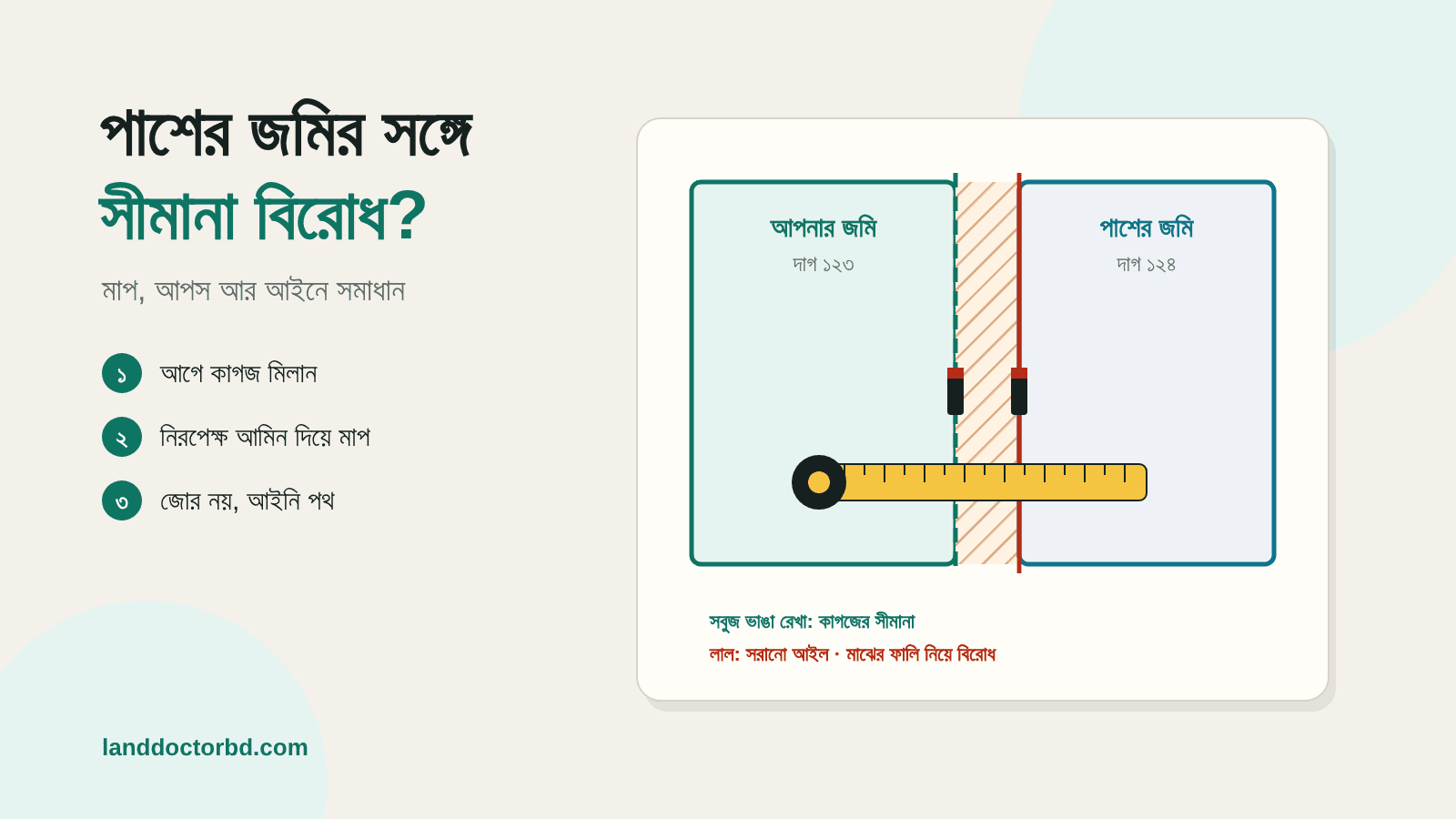
What this post covers
Short answer
A boundary dispute is usually settled in four steps:
- Check the papers. See what your own deed, the latest khatian and the mouza map say about your plot and its area.
- Have it measured by a neutral amin. Have the measurement done in front of both sides, against one and the same map, and take a written report.
- Settle it on the result of the measurement. Sit down with the elders or at the union parishad arbitration; whatever is agreed, put it in writing.
- If that fails, take the legal way. For a broken boundary mark or possession taken by force, the police station or the executive magistrate; for a serious dispute about ownership and the boundary, the civil court.
Whatever happens, do not break the ridge yourself, and do not take possession by force.
Basis of information: The rules and fees in this post are based on the laws, government directions and news published up to October 2026 (the sources are listed below). Rules and fees can change. For the final position, confirm with your nearest upazila land office or with an expert.
Why boundary disputes happen
Behind most boundary disputes there is one of four causes:
- The ridge or the post has moved. Ploughing, cutting earth or a flood moves the ridge; sometimes somebody moves it on purpose.
- The papers and the ground do not agree. There is less land on the ground than on the deed; or the khatian and the map give the plot a different size.
- The heirs' division was never put on paper. A division by word of mouth with no drawing — and in the next generation a dispute about who is where.
- An earlier measurement was wrong. An unskilled amin, or measuring against the map of a different survey.
Once you understand the cause, the remedy is easier too: if the ridge has moved, a measurement is enough, but if the papers disagree, the papers have to be put right first.
Check the papers first
Have the papers below in hand before you measure. Without them a measurement rests on nothing.
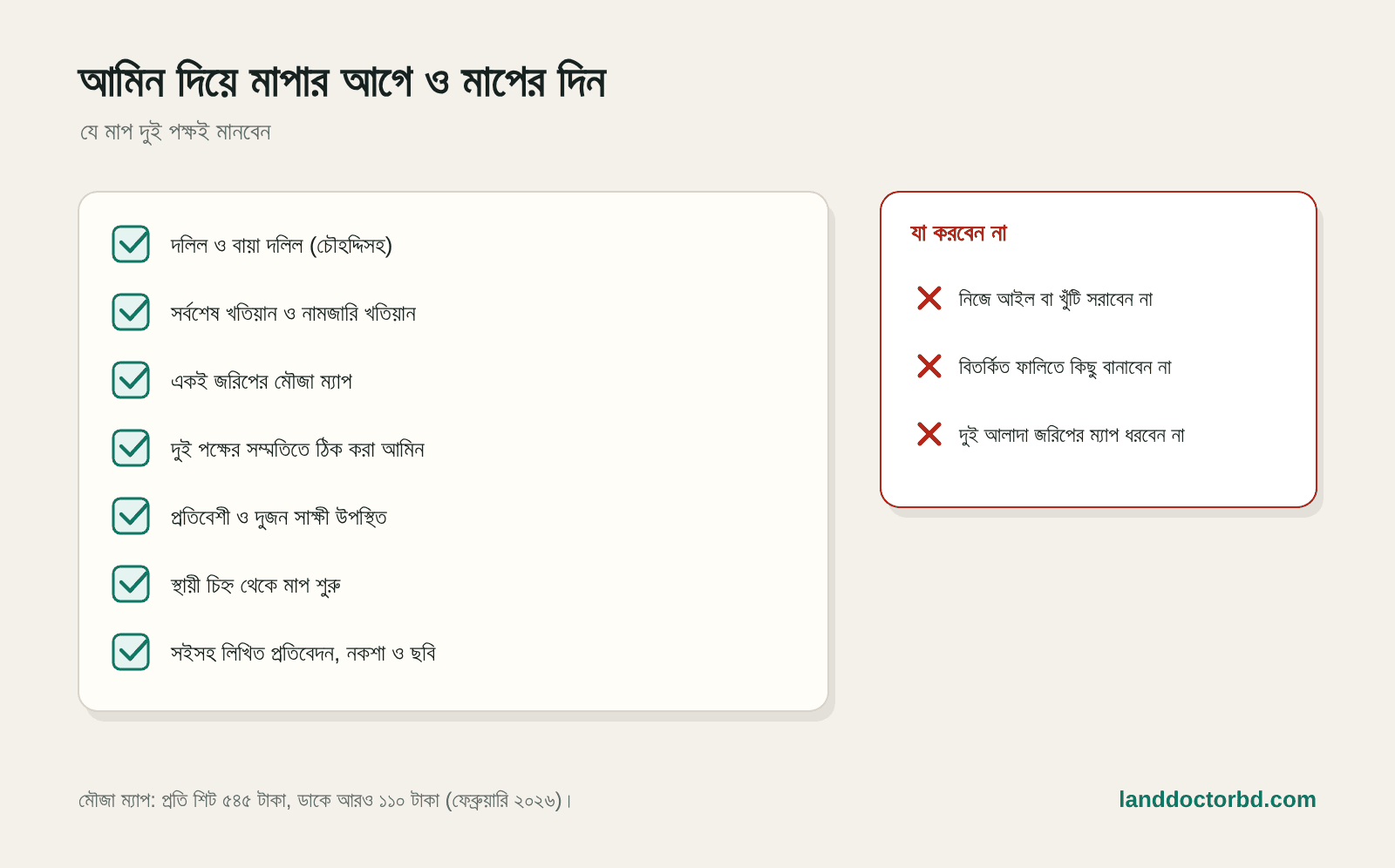
- The deed and the parent deed. Which plot, and how much of it, you bought or were given, and what the boundaries (whose land lies on each of the four sides) say.
- The latest khatian. Your name, the plot number and the area. A copy can be taken online (dlrms.land.gov.bd) or from the office.
- The mouza map. The map of the survey the khatian belongs to. Under the land ministry's schedule of fees a sheet costs 545 taka, and another 110 taka to send it by post (February 2026).
- The mutation khatian and the land tax receipt. The proof that the land is up to date in your name.
- What is on your neighbour's papers. Knowing what their deed and khatian say cuts down the argument on the day of the measurement.
One important thing: If the two sides measure against the maps of two different surveys (one with the CS, say, and the other with the RS), the results will never agree. Settle first which map it is to be measured against — usually the map of the latest final survey.
How to get a neutral measurement
The measurement is the strongest evidence in a boundary dispute. So that both sides accept it:
- Choose the amin between you. A measurement by an amin one side brought is not usually accepted by the other.
- Give notice of the day beforehand. So that the neighbour, and one or two local people as witnesses, can be present.
- Start the measurement from a permanent mark. From a road, a concrete post, or some permanent point that is on the map.
- Take a written report and a drawing. Which map it was measured against, how much land was found in whose plot, and the amin's signature — have all of it in writing.
- Put boundary posts in and photograph them. If both sides agree, set concrete posts; keep the photographs of the posts and the measurement, with the date on them.
In a civil case the court can also appoint a survey commissioner of its own to have the land measured. But a neutral measurement made before the case makes a settlement far easier.
From a settlement to the legal way: which, and when
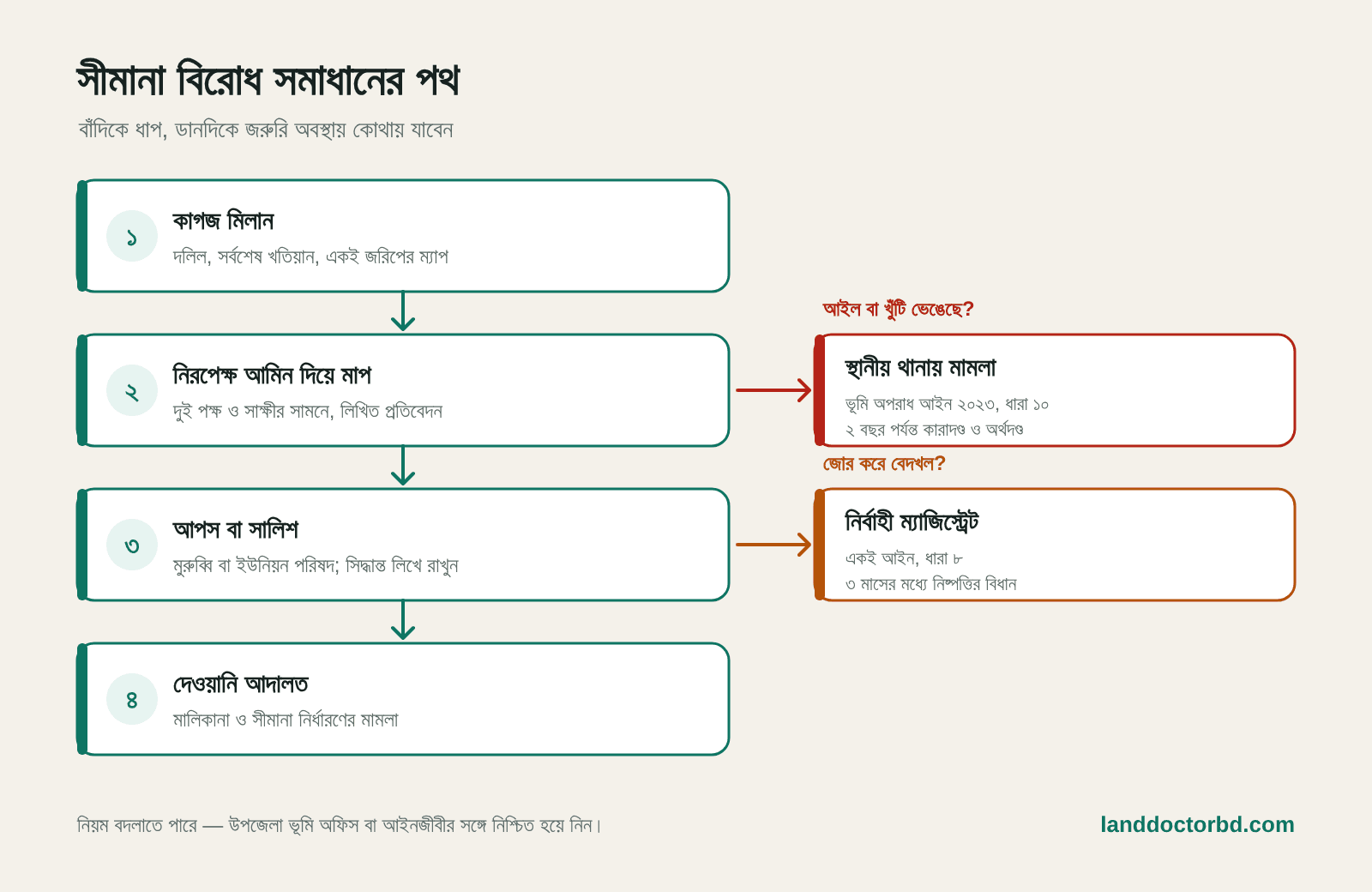
A settlement first. Take the report of the measurement and sit down with the elders of the family or at the union parishad arbitration. Whatever is agreed, put it in writing with the signatures of both sides and of a witness. If in the settlement one of you gives up land to the other or exchanges it, that is not firm without a registered deed.
If there is no settlement, choose the way that fits the situation:
| The situation | Where to go | What the law says |
|---|---|---|
| Somebody has destroyed the ridge, a post or a boundary mark | The local police station | Land Crimes Prevention and Remedy Act 2023, section 10 — up to 2 years' imprisonment and a fine |
| You have been dispossessed by force, without an order of the court | The executive magistrate for the area | The same Act, section 8 — provides for settlement within 3 months, after hearing both sides and seeing the land |
| The dispute is about the ownership itself: whose land runs how far | The civil court (through a lawyer) | A suit for a declaration of title and for fixing the boundary; the court can have it measured by a survey commissioner |
Every offence under this Act is cognisable, which means a case can be filed at the police station directly. Remember this: an application under section 8 cannot be made if a civil case about the same possession is already going on, unless the court itself sends the matter to the magistrate.
What never to do
- Do not move the ridge at night, or on your own. You can find yourself caught by the offence under section 10.
- Do not build a house, a wall or anything permanent on the disputed strip. If you lose the case it has to come down, which costs more money and makes the dispute worse.
- Do not take possession by force, or by gathering a crowd. Even if the land is yours, taking possession by force is the cause of a fresh case.
- Do not pay anybody without a receipt. If extra money is asked for a government land service, a complaint can be made on 16122.
When to get expert help
A small dispute over a ridge is often settled by a single measurement in front of the elders. In the situations below an expert saves both time and money:
- Your neighbour will not accept the measurement by your amin
- The deed, the khatian and the map each give a different area
- You cannot even agree which survey's map it is to be measured against
- Your neighbour is putting up a house or a wall and something has to be done quickly
- The police station, the magistrate or the civil court — you cannot tell which way to go
A verified LandDoctor expert will look at your papers and explain which map it ought to be measured against and which way to go about it. In Dhaka and Gazipur districts an experienced amin can measure the land on the spot and write a report; anywhere in the country, advice online and by telephone. The first 10 minutes of advice are free.
Common questions
My neighbour has moved the ridge and come onto my land. What do I do first?
Rather than quarrelling, first take photographs, with the date on them. Then check the papers and have the land measured by an amin both sides accept. If a boundary mark has been destroyed on purpose, a case can be filed at the police station.
Does an amin's measurement count as evidence in court?
A written measurement made in the presence of both sides, with witnesses, is very useful in a settlement, and can be put forward in a case as a supporting paper. In a case, though, the court usually gives weight to the measurement of the survey commissioner it has appointed itself.
The CS and the RS maps give different measurements. Which do I go by?
Usually the map and khatian of the latest final survey are taken. But if there is an error in the latest record itself, that error may have to be corrected first. Our post "A name, plot number or area wrong on the khatian" sets out the way to that.
There is less land on the ground than on the deed. What do I do?
First see how much the khatian gives, and how much the whole plot comes to. Adding up the shares of the other owners in the same plot often shows where the shortfall is. Then have a neutral measurement made, and take an expert's advice if you need it.
Can a boundary dispute be settled at the union parishad?
Yes, many disputes are settled at the union parishad arbitration or in the village court. Ask your union parishad which disputes can be taken to the village court. A serious dispute about ownership has to go to the civil court.
My neighbour is putting up a wall on my land. What can be done right now?
Take your papers of title and possession and speak to a lawyer quickly. Along with a civil suit, a temporary order can be asked of the court to stop the building. If you leave it, having it taken down later is harder.
Sources
Written by LandDoctor team · Last updated: 8 November 2026
- ভূমি অপরাধ প্রতিরোধ ও প্রতিকার আইন, ২০২৩ — বাংলাদেশ আইন (bdlaws) (২০২৩)
- ভূমি অপরাধ প্রতিরোধ ও প্রতিকার আইন ২০২৩ বিষয়ে জানেন কি — দ্য ডেইলি স্টার বাংলা (জুন ২০২৪)
- কোন সেবায় কত ফি, টাঙাতে হবে সব ভূমি অফিসে — বাংলা ট্রিবিউন (ফেব্রুয়ারি ২০২৬)
- অনলাইনে খতিয়ানের কপি — bdnews24 (নভেম্বর ২০২৫)
This post is general information, not legal advice. Every dispute stands differently, and government rules and fees change from time to time. For the latest information see land.gov.bd, or contact your nearest upazila land office.