Blog
Has somebody taken possession of your land? The legal ways to get it back
Written by LandDoctor team ·
What this post covers
Short answer
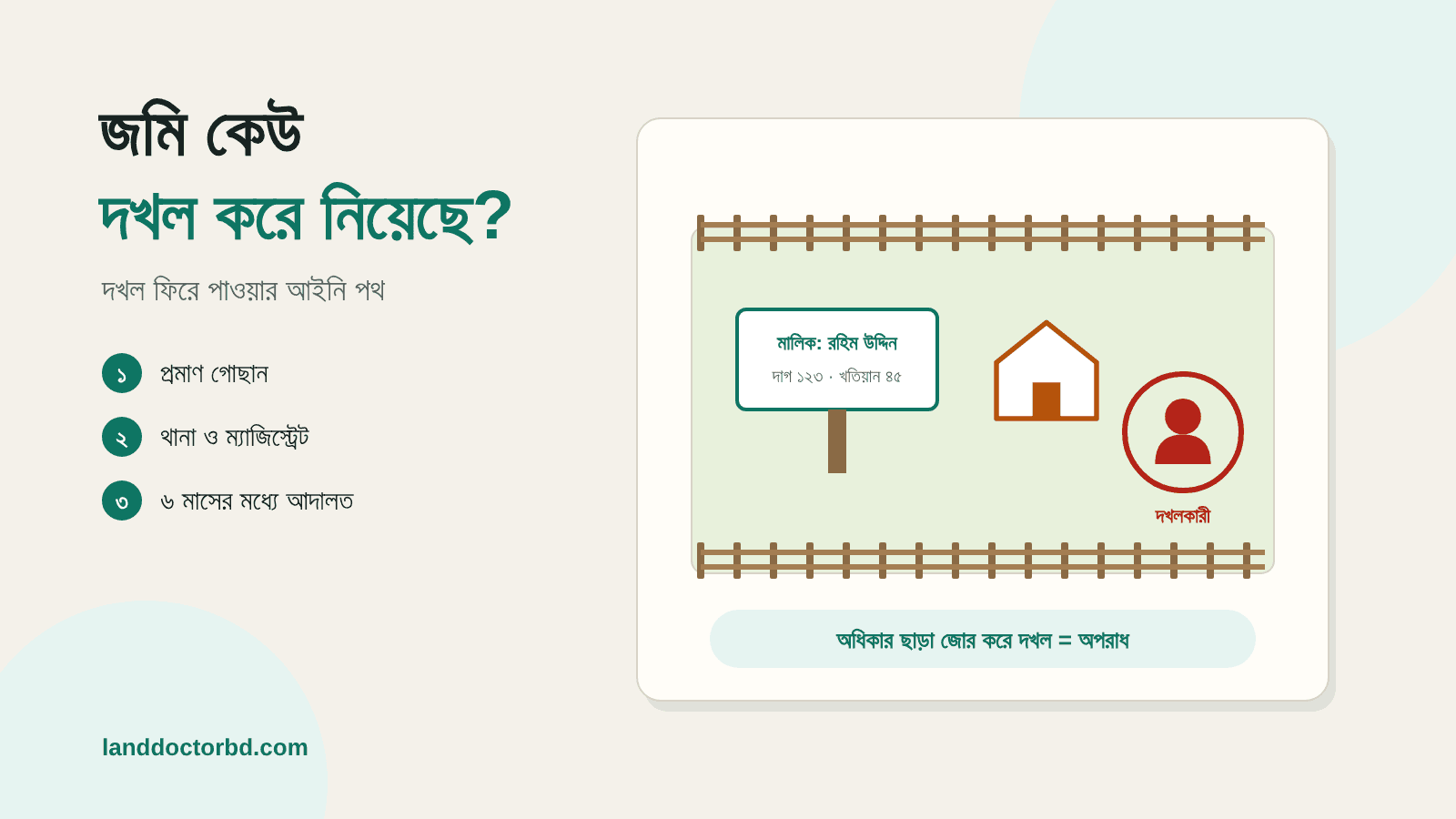
Taking possession of land by force is now a punishable offence in itself. If it happens, do not wait:
- Gather the evidence. Photographs, video, witnesses, and your deed, khatian and land tax receipts.
- File a GD or a case at the police station. Under the Land Crimes Prevention and Remedy Act 2023, taking possession by force carries up to 2 years' imprisonment and a fine.
- Apply to the executive magistrate to have possession restored. The law says it is to be settled within 3 months of the application being received.
- Go to the civil court if you have to. Within 6 months of being dispossessed, a case can be filed on the loss of possession alone, without proving ownership; after that, you have to prove ownership.
Do not gather a crowd and go to take the land back yourself. That can land you in a case instead.
Basis of information: The rules in this post are based on the laws and news published up to October 2026 (the sources are listed below). The law and the procedure can change. Confirm with a lawyer or an expert which way is right in your case.
Whom the law gives the right to be in possession
Under section 7 of the Land Crimes Prevention and Remedy Act 2023, only these people may be in possession of land:
- The person named as owner on the latest valid khatian
- That owner's heirs
- A person who has taken ownership or the right of possession under a valid deed
- A person who has been given ownership or possession by an order of the court
Where somebody holds that right, it is an offence to evict them or to stop them entering the land without an order of a court or of the authorities. So the clearer your papers are — and above all an up-to-date mutation khatian — the easier it is to get possession back.
What to do in the first week after it happens
- Keep your head, and keep out of a fight. If it comes to blows with the occupier, the case can turn the other way.
- Keep the evidence. Take photographs and video of the occupation, with the date on them; a new fence, a house, ploughing — whatever it is. Write down the names and telephone numbers of everybody who saw it.
- Put the papers together. The deed, the parent deed, the mutation khatian, the land tax receipt, the mouza map — a photocopy of all of it. Keep the originals somewhere safe.
- File a GD or a case at the police station. Write down when, who and how possession was taken, with the plot and khatian numbers. Offences under this Act are cognisable, which means the police can take a case directly.
- Tell the local representative and the administration. You can tell the UP chairman or the councillor; a written complaint can also be made to the upazila nirbahi officer (UNO) or the deputy commissioner.
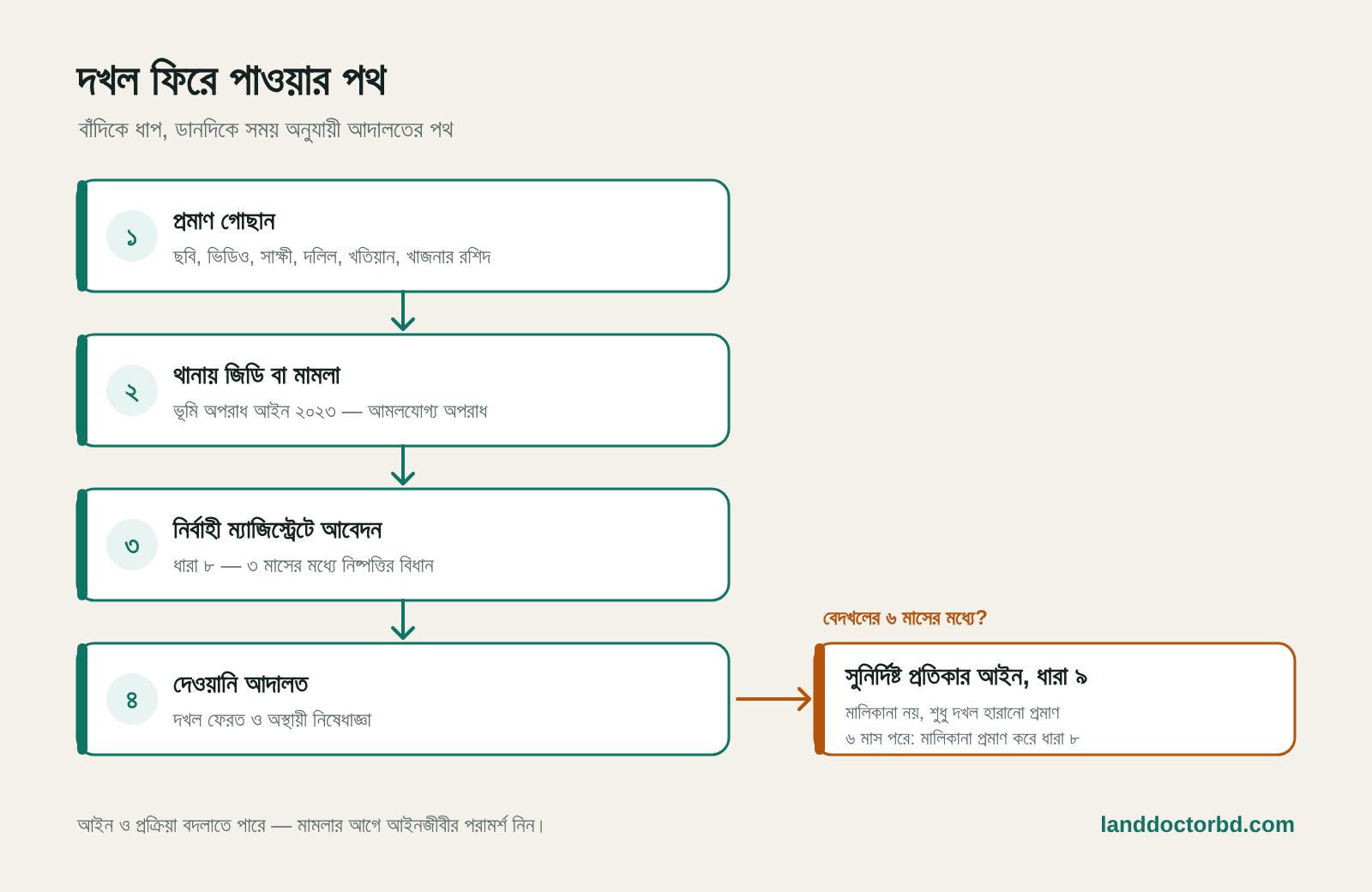
The three legal ways of getting possession back
| The way | When | What happens |
|---|---|---|
| An application to the executive magistrate (Land Crimes Act, section 8) | You have been dispossessed by force, without an order of the court | Provides for settlement and the return of possession within 3 months, after hearing both sides and investigating on the spot. Disobeying the order carries up to 2 years' imprisonment |
| A case at the police station (Land Crimes Act, section 7) | Somebody is holding the land by force, or will not let you in | A criminal trial; the punishment is up to 2 years' imprisonment and a fine. The trial is to be finished in 180 days |
| A suit in the civil court (the Specific Relief Act) | Within 6 months of dispossession: section 9; after that: section 8, proving ownership | The court orders possession returned; while the case is going on, a temporary injunction can be asked for to stop building |
Three important things:
- If a civil case about the same possession is already going on, an application to the magistrate under section 8 does not lie, unless the court itself sends the matter to the magistrate.
- The 6 months under section 9 matter a great deal. Within that time you need prove only your earlier possession and the fact of dispossession, not ownership. Leave it, and you are into the long case of proving full title.
- If the occupier starts building, speak to a lawyer quickly. Once a house is up, having it removed later is much harder.
What to do beforehand to keep the land from being taken
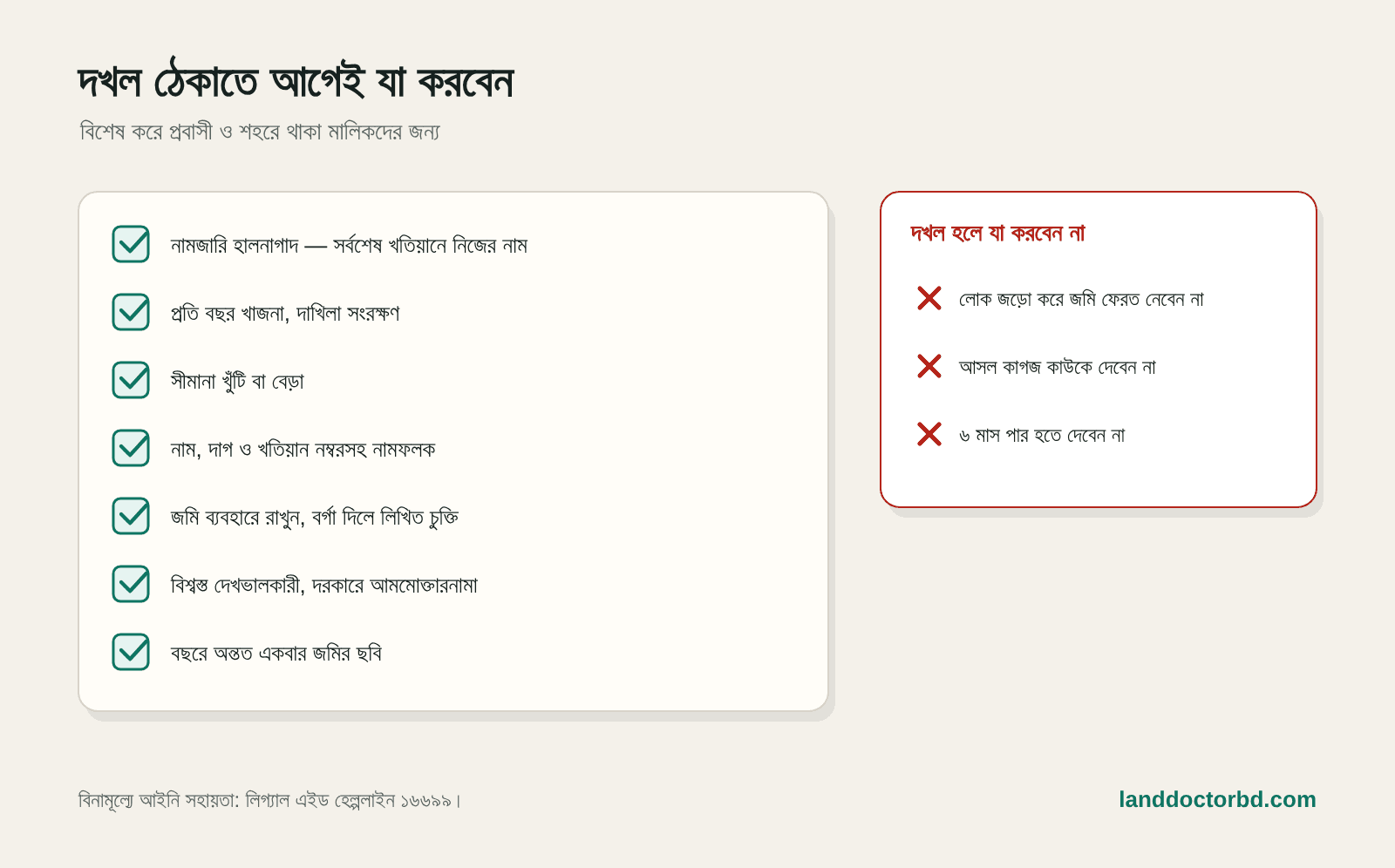
The risk is greatest for those living abroad or in the city, whose land in the village lies empty. Have these done beforehand:
- Keep the mutation up to date. With your name on the latest khatian, the law is at its strongest on your side.
- Pay the land tax every year. Land development tax can now be paid online; the receipt also serves as evidence of possession.
- Put in boundary posts or a fence. Where you can, put up a name board with your name and the plot and khatian numbers.
- Keep the land in use. Cultivation, an orchard, or letting it out to a sharecropper under a written agreement keeps the land from lying empty.
- Give somebody trustworthy charge of looking after it. If you live abroad, give somebody legal charge through a power of attorney where that is needed; have photographs of the land sent to you at least once a year.
What it costs, and free legal aid
A civil case costs both a lawyer's fee and time, so consider the magistrate and the police station first. If you cannot afford it, a lawyer may be available at the government's cost through the National Legal Aid Services Organisation (legal aid). Contact the district legal aid office, or telephone the toll-free helpline on 16699.
When to get expert help
In a case of occupation, a mistake at the start grows large later. Take an expert's advice at the outset in the situations below:
- The mutation has not been done in your name, or the khatian carries somebody else's
- The occupier is producing a deed of their own
- The 6 months from the dispossession are running out
- You are abroad or far away and cannot run about yourself
- The police station, the magistrate or the civil court — you cannot tell which to go to first
A verified LandDoctor expert will look at your papers and explain which way is quickest and safest for you, and what evidence you will need. Advice online and by telephone anywhere in the country; in Dhaka and Gazipur districts the land can be seen and measured on the spot. The first 10 minutes of advice are free.
Common questions
A relative is occupying my land. Does the same law apply?
Yes. Even where the occupier is a relative, taking possession by force without a valid right is the same offence. But on inherited land, where it is not settled which share belongs to which co-sharer, the question of partition has to be settled first. Our post "How to divide your parents' land" sets out the way to that.
The 6 months since the dispossession have passed. What now?
A case can still be filed, but by proving ownership. That needs the full set of papers — the deed, the khatian, the land tax receipts — and it takes longer. The law sets down no particular time limit for an application to the magistrate under section 8, but the sooner you make it the better.
The occupier is producing a forged deed. What do I do?
Making or using a forged deed carries up to 7 years' imprisonment under section 5 of the Land Crimes Act. Take a certified copy of the deed from the sub-registry office and compare them, then file a case on a lawyer's advice.
The police will not take the case. What do I do?
Keep the received copy of your written complaint. A complaint case can then be filed through a lawyer directly in the court of the judicial magistrate.
Can a case be run from abroad?
Yes. Through a power of attorney attested at the embassy you can give somebody in the country charge of running the case and making applications on your behalf. An application under section 8 can also be made through a representative.
Where do I report somebody occupying khas or government land?
Report it in writing to the upazila land office or the upazila nirbahi officer. Occupying government land, or land in public use, is punishable under the same Act.
Sources
Written by LandDoctor team · Last updated: 11 November 2026
- ভূমি অপরাধ প্রতিরোধ ও প্রতিকার আইন, ২০২৩ — বাংলাদেশ আইন (bdlaws) (২০২৩)
- ভূমি অপরাধ প্রতিরোধ ও প্রতিকার আইন ২০২৩ বিষয়ে জানেন কি — দ্য ডেইলি স্টার বাংলা (জুন ২০২৪)
- জমি দখল হলে করণীয় — যুগান্তর (ডিসেম্বর ২০২৫)
- Recovery of possession under the Specific Relief Act — The Daily Star (মার্চ ২০১১)
- সরকারি খরচে আইনি সহায়তা — দ্য ডেইলি স্টার বাংলা (অক্টোবর ২০২৬)
This post is general information, not legal advice. Every case stands differently, and the law and the procedure change from time to time. Take a lawyer's advice before filing a case.