Blog
How to divide your parents' land: from the succession certificate to the deed of partition
Written by LandDoctor team ·
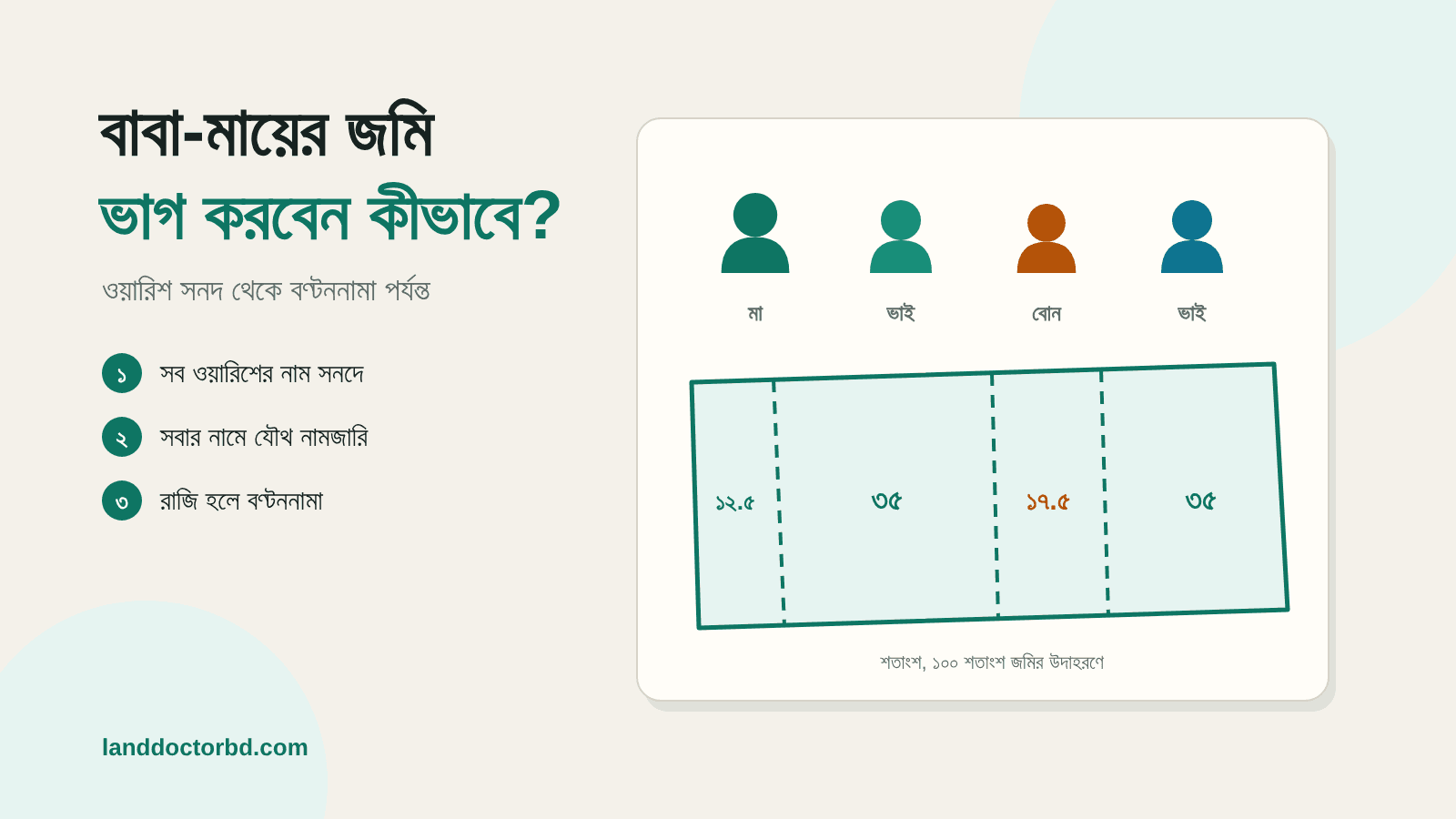
What this post covers
Short answer
Dividing land that has come by inheritance takes four things, in this order:
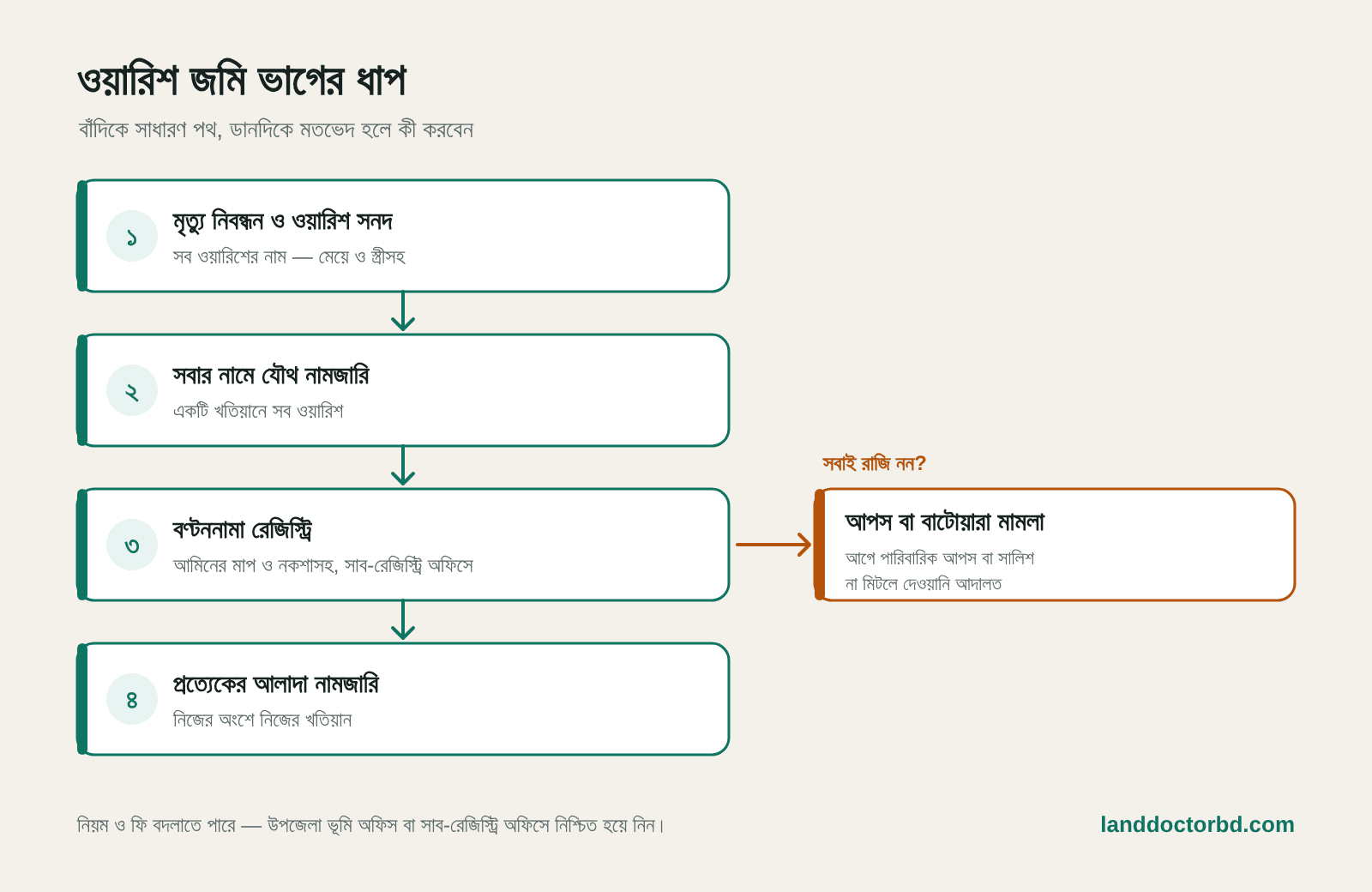
- Register the death and get the succession certificate. The certificate has to name every heir — sons, daughters, the wife or the husband, and the parents where they apply.
- Have the mutation done jointly, in all the names. Even before it is divided, the land can be put on one khatian in the names of all the heirs.
- If everybody agrees, register a deed of partition. Who takes which part has to be written out, with a map, and registered at the sub-registry office.
- With the deed of partition, each of you has a separate mutation done.
If you cannot agree, try to settle it within the family or at the local arbitration; if that fails, a partition suit has to be filed in the civil court.
Basis of information: The rules in this post are based on the laws, government rules and news published up to October 2026 (the sources are listed below). What is given here are the main rules of Muslim inheritance; the arithmetic can be different for each family. For the final shares and the procedure, confirm with your nearest upazila land office, the sub-registry office, or an expert.
The first job: get the list of all the heirs right
Every piece of trouble over dividing land starts with a wrong or incomplete list of heirs. Settle that first:
- Register the death. You apply online (bdris.gov.bd) and hand it in at the union parishad, the municipality or the city corporation. Done within 45 days of the death, it costs no fee.
- Get the succession certificate (warish sonod). It is issued by the union parishad, the municipality, or the ward office of the city corporation.
- Check whether anybody has been left off the certificate. A daughter, a wife, a parent — if any of them is left out, the mutation gets stuck later, and there are disputes too.
Grandchildren can be heirs as well. If their own father or mother died before the grandfather, then under the Muslim Family Laws Ordinance of 1961 they take the share that the dead parent would have taken had they lived.
Do not leave the sisters' names out. Research has found that in many families the succession certificate is made out leaving the daughters off. It is unjust, and under the present rules an application for mutation needs the names of all the heirs — so doing it this way lands you in serious legal trouble later.
Who gets how much: the main rules of Muslim inheritance
Before the land is divided, the cost of the burial and the debts of the person who has died are paid; any bequest (osiyat) is honoured. What is left is then divided between the heirs. The main shares are these:
| Heir | With children | Without children |
|---|---|---|
| Wife | 1/8 | 1/4 |
| Husband | 1/4 | 1/2 |
| Father | 1/6 | All that is left (after the sharers) |
| Mother | 1/6 | 1/3 (if there is not more than one brother or sister) |
| Daughter (no son) | One daughter 1/2; two or more take 2/3 between them | — |
| Sons and daughters together | What is left; each daughter half of each son | — |
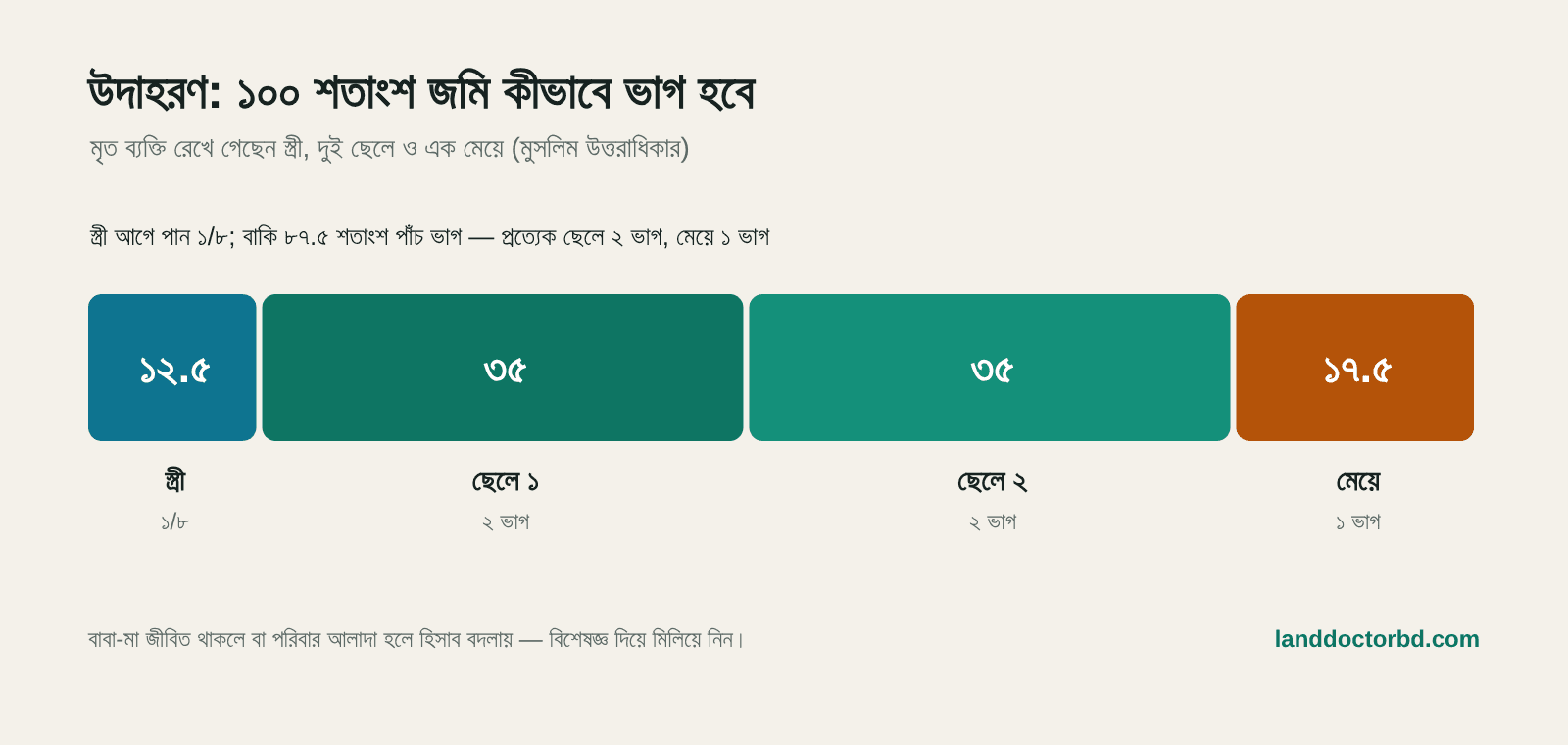
An example: A father has died, leaving a wife, two sons and a daughter; his own parents had died before him. If the land is 100 decimals:
- The wife takes 1/8, that is 12.5 decimals.
- The remaining 87.5 decimals are divided into five — 2 parts to each son, 1 part to the daughter.
- Each son takes 35 decimals, and the daughter 17.5 decimals.
If a parent of the person who has died is alive, or if there are no children, the arithmetic changes. In a complicated family, have the shares worked out by an expert. Inheritance in Hindu, Buddhist and Christian families follows different laws; in that case be sure to take an expert's advice.
The three ways of dividing the land
| Way | When | What it gives you |
|---|---|---|
| Joint mutation | The land has not been divided yet | One khatian in the names of all the heirs; the land tax can be paid and the ownership goes on the record |
| Registering a deed of partition | All the heirs agree on who takes which part | Each of them can have a separate mutation done on their own part |
| A partition suit | Somebody will not agree, or cannot be reached | The court settles the division; it costs more time and more money |
Under the mutation rules of February 2025, where there has been no partition the mutation is done jointly, on one khatian in the names of all the heirs. Separate khatians need a registered deed of partition. A division agreed by word of mouth, or written on plain paper, will not get you separate mutations.
The steps of making a deed of partition
- Sit down together and settle the division. Who takes which side — the roadside, the pond, the homestead — settle that beforehand.
- Have the land measured by an amin. Have the boundaries and a drawing of each share made; that is what goes with the deed of partition.
- Have the deed of partition drawn up by a deed writer. The name of every heir, the shares, the plot numbers and the boundaries have to be written out plainly.
- Register it at the sub-registry office. Usually all the heirs have to be present; where one of them lives abroad, through a valid power of attorney. Ask the office what the registration fee and the duty come to.
- With the registered deed of partition, each of you has a separate mutation done.
When the heirs do not agree
- Try to settle it first. Many disputes are settled without a case at all by sitting down with the elders of the family or at the union parishad arbitration. Whatever is agreed, register it in a deed of partition.
- If that fails, a partition suit. File a case in the civil court and the court will settle each person's share. It takes time, so get your papers in order and go through a lawyer.
- Do not take possession by force. Under the Land Crimes Prevention and Remedy Act 2023, taking possession of land by force without owning it is a punishable offence. Even between co-sharers, possession beyond your own share only makes the dispute worse.
When to get expert help
When all the heirs agree, the job is a simple one. In the situations below an expert helps keep both the arithmetic and the papers right:
- The family does not agree on who gets how much
- The land of the generation before has still not been divided, or had no mutation done
- A name has been left off the succession certificate, or is wrong on it
- One of the heirs lives abroad, or cannot be reached
- The land needs measuring before the division, to settle each person's boundary
A verified LandDoctor expert will look at your family's list of heirs and the land papers and explain the shares, the way to divide them and the papers you need; an amin can measure the land on the spot as well (in Dhaka and Gazipur districts). The first 10 minutes of advice are free.
Common questions
Under Muslim law, does a sister take half of what a brother takes?
Where there are both sons and daughters, each daughter takes half of what each son takes. Where there is no son, the daughters take a fixed share: one daughter takes a half, and two or more take two-thirds between them.
Do the children of a son who died before his father inherit the grandfather's land?
Yes. Under the Muslim Family Laws Ordinance of 1961 they take the share their father would have taken had he lived.
Can I sell my own share without the land being divided?
You can sell your own share, but there is a risk in it: because it is not settled which part of the land belongs to whom, there can be a dispute with the buyer, and if you sell to an outsider the other co-sharers may claim pre-emption. It is safer to make the deed of partition first.
We have divided it by word of mouth. Is that enough?
No. A division by word of mouth, or written on plain paper, will not get you separate mutations, and it is a great cause of disputes in the next generation. Make a registered deed of partition.
One brother lives abroad. How can the deed of partition be made?
He can give charge to somebody in the country through a power of attorney attested at the embassy. It has to be registered in Bangladesh; that person then signs the deed of partition on his behalf.
A name has come out wrong on the succession certificate. What should I do?
Apply with your evidence for a correction at the office that issued the certificate. Having a mutation done on a wrong certificate can hold the whole process up later.
Sources
Written by LandDoctor team · Last updated: 4 November 2026
- মুসলিম উত্তরাধিকারেরা কে কতটুকু সম্পত্তি পান? — প্রথম আলো (ফেব্রুয়ারি ২০১৭)
- ওয়ারিশদের যৌথ নামজারি ও বণ্টননামা — যুগান্তর (সেপ্টেম্বর ২০২৬)
- নতুন আইনে জমির নামজারির নিয়ম কী — দ্য ডেইলি স্টার বাংলা (আগস্ট ২০২৬)
- মৃত্যু নিবন্ধন কীভাবে করবেন — bdnews24 (হালনাগাদ আগস্ট ২০২৬)
- ভূমি অপরাধ প্রতিরোধ ও প্রতিকার আইন ২০২৩ — দ্য ডেইলি স্টার বাংলা (জুন ২০২৪)
- Can I see your papers, please? — Dhaka Tribune (অক্টোবর ২০১৪)
This post is general information, and not a final statement of the law or of religious rules. Every family's situation is different, and government rules and fees change from time to time. For the latest information see land.gov.bd, or contact your nearest upazila land office.