Blog
What to check before buying land: 10 checks that catch hidden trouble
Written by LandDoctor team ·
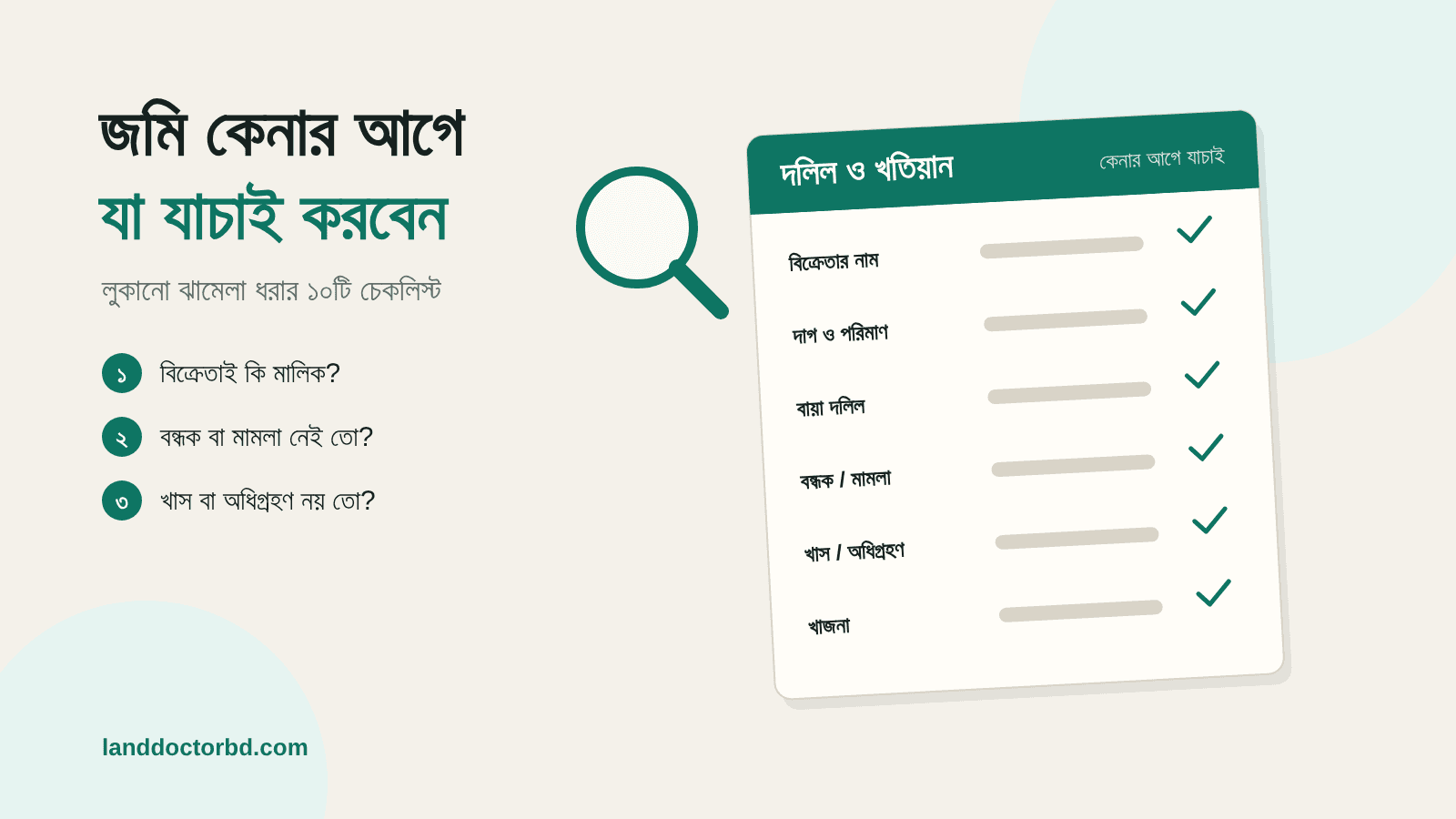
What this post covers
Short answer
Before you hand over the money for land, make sure of at least these five things:
- The seller really is the owner. The seller's name on the latest khatian and on the mutation, and the whole chain of deeds by which it came to them (the parent deeds).
- The land has not already been sold or mortgaged. Have a search made at the sub-registry office; ask whether it is mortgaged against a bank loan.
- The land is not government land or on a list for acquisition. Buy khas land, vested property or land that has been acquired and you will not get the ownership.
- The ground and the papers agree. Have it measured by an amin; see who is in possession, and whether there is a way in and out.
- The land tax is up to date and there is no case. Look at the receipts; ask the neighbours and local people about any dispute.
If any one of them does not add up, stop paying and settle that first.
Basis of information: This post is based on the government directions and news published up to October 2026 (the sources are listed below). Rules and costs can change. For the final position, confirm with your nearest upazila land office, the sub-registry office, or an expert.
Why checking matters so much
If a problem comes to light after you have bought land, getting the money back is hard, and a case takes year after year. Many land disputes begin in a sale like that, where the papers were not properly looked at before buying. Under the present rules land cannot be bought or sold without a mutation or a khatian — but if there is a gap in the seller's papers, it is the buyer's business to catch it.
Whether the seller really is the owner
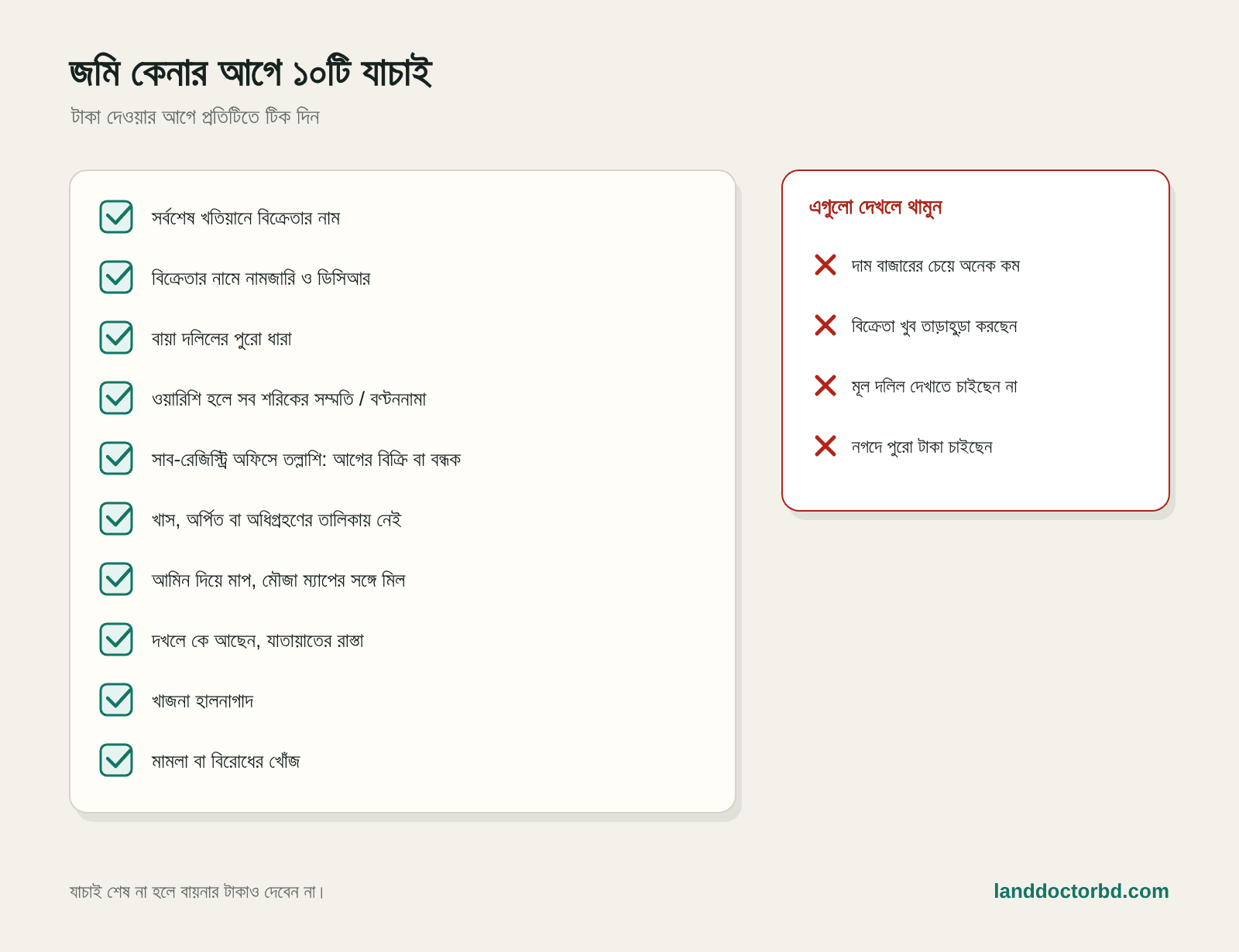
- Check the name against the latest khatian. The khatian can be seen online (dlrms.land.gov.bd). See whether the seller's name, the plot number and the area agree.
- Look at the mutation khatian and the DCR. If the seller bought the land, whether the mutation was done in their name.
- Follow the chain of parent deeds. Whom the seller got the land from, and whom that person got it from — as far back as you can, down to the khatian of an old survey. Wherever there is a gap in the chain, that is where the risk is.
- On inherited land, see that all the heirs consent. One co-sharer cannot sell the whole land. Without a deed of partition it stays unclear which share you are buying.
- Check the seller's NID. Whether the name, the father's name and the address on the khatian and the deed agree with the NID. If an attorney is selling, see that the power of attorney is registered and valid.
Whether the land is already sold, mortgaged or caught up in a case
- Have a search made at the sub-registry office. For a set fee you can see whether any deed has been registered on that plot before — a sale, a gift or a mortgage.
- Ask about a bank mortgage. If the land is security for a loan, do not buy it without the papers showing the loan repaid and the mortgage released.
- Ask about cases. Ask the neighbours, the local elders and the union parishad. Where you need to, a search for cases in the courts can be made through a lawyer.
- Beware of an attempt to sell the same land to two people. If you pay earnest money, register the agreement to sell, so that a search will turn it up if somebody else goes to buy the same land later.
Whether the land is government, khas or on a list for acquisition
| What to check | Where to ask | Why it matters |
|---|---|---|
| Whether it is khas land | The upazila land office (AC Land) | Khas land cannot be owned privately |
| Whether it has been acquired, or is proposed for acquisition | The land acquisition section of the deputy commissioner's office | Buy land that is being acquired and you will not even get the compensation |
| Whether it is on the list of vested property | The upazila land office / the district administration | Land on that list brings disputes and cases |
| Road widening or a town plan | RAJUK, the city corporation or the municipality | Permission to build a house can be held up |
If you are buying to build a house in a town or on its outskirts, find out beforehand as well whether the land falls in an area approved for residential use.
What to look at when you go to the land
- Have it measured by an amin. Measure it against the mouza map and see whether the area on the papers is there on the ground, and where the boundary runs.
- See who is in possession. If the seller is not in possession themselves, why the person who is there is there — a tenant, a sharecropper, or somebody with a claim.
- Whether there is a way in and out. Whether the path is a public one or runs over somebody else's land — and whether there is a right to it in writing.
- Talk to the neighbours. A boundary dispute, a family case, or an earlier sale — more often than not it is they who know of it.
- Look at the land tax receipts. Whether the land development tax is up to date; if anything is owing, put it in the agreement who is to pay it.
The steps of buying, and what registration costs
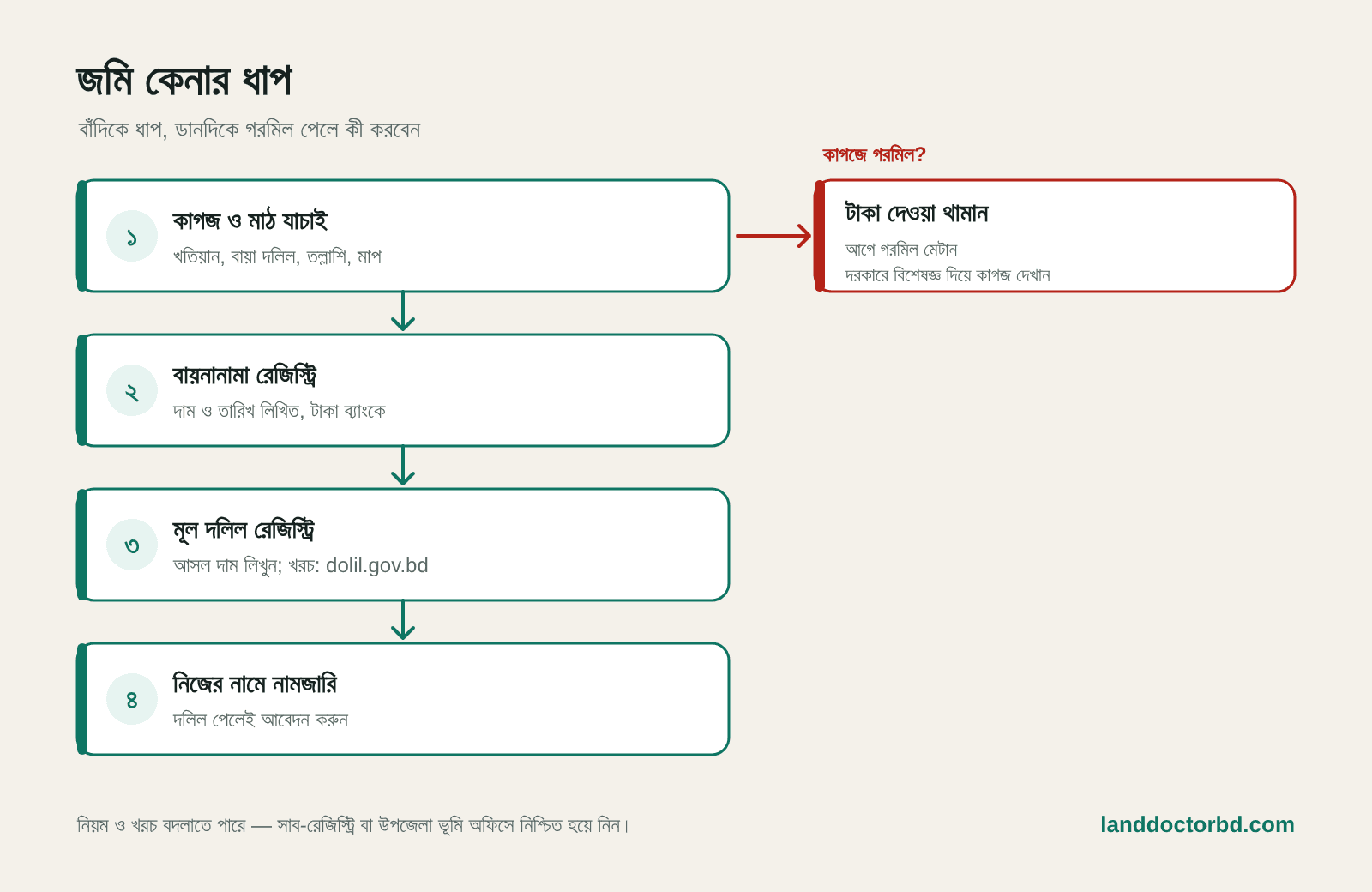
- Finish the checking. Put all the papers above and what you found on the ground side by side.
- Register the agreement to sell (baynanama). Write down the price, the instalments and the date of registration, and register it at the sub-registry office. Pay through a bank, so that there is proof.
- Register the deed itself. Write the real price in the deed. Showing a lower one is your own loss later, on a sale or on the compensation for an acquisition.
- Have the mutation done in your name as soon as the deed is in your hands. Without the mutation the khatian goes on carrying the seller's name.
The cost: The cost of registration is made up of stamp duty, the registration fee, the local government tax, tax at source and several other small fees. Tax at source differs with where the land is, so the total depends on the place and the price. Put the district, the sub-registry office and the price into the government deed calculator (dolil.gov.bd) and see the costs worked out.
When to get expert help
For most families, buying land is the largest spending of their lives. If any one of the following is true, have the papers looked at by an expert before you pay:
- The mutation has not been done in the seller's name, or the khatian carries somebody else's
- There is a gap in the chain of parent deeds, or the old deeds are missing
- It is inherited land, but there is no deed of partition
- The sale is through an attorney and the real owner is abroad
- The price is far below the market, or the seller is in a great hurry
A verified LandDoctor expert will put the khatian, the parent deeds and the map side by side and tell you in writing where the risks are. Advice online and by telephone anywhere in the country; in Dhaka and Gazipur districts the land can be seen and measured on the spot. The first 10 minutes of advice are free.
Common questions
Is seeing the khatian online enough on its own?
No. The khatian online shows whose name is on the record. But to know whether there has been a sale, a mortgage or a case since the record was made, you need both a search at the sub-registry office and enquiries on the ground.
How far back should I follow the parent deeds?
As far as you can get them. It is best to match the whole chain from the person whose name was on the khatian of an old survey (the CS or the SA, say) down to the seller. If the deed for one of the transfers in between is missing, that is a sign of risk.
What should I look at when buying a flat or a plot from a developer?
Besides the papers of title to the land, look at the registered agreement between the landowner and the developer, and the plan approved by RAJUK or the local authority. If it is a plot project, find out whether the project itself has been approved.
Writing a lower price in the deed saves money. What is wrong with it?
It saves something, but showing a lower price in the deed is risky: a lower value may be taken later on a sale, a loan or the compensation for an acquisition, and hiding the real price can cause trouble in law.
Can land be bought from abroad?
Yes, by giving a power of attorney to somebody you trust. But see that the checking is done by somebody neutral on your side — not by the seller's man.
Sources
Written by LandDoctor team · Last updated: 15 November 2026
- নতুন আইনে নামজারি: কী নিয়ম, কেন জরুরি ও কী কী লাগবে — ইত্তেফাক (সেপ্টেম্বর ২০২৬)
- জমি নিবন্ধন খরচের হিসাব জানা যাবে এক ক্লিকে — প্রথম আলো (এপ্রিল ২০২৩)
- অনলাইনে খতিয়ানের কপি — bdnews24 (নভেম্বর ২০২৫)
- কোন সেবায় কত ফি — বাংলা ট্রিবিউন (ফেব্রুয়ারি ২০২৬)
- ভূমি অপরাধ প্রতিরোধ ও প্রতিকার আইন, ২০২৩ — বাংলাদেশ আইন (bdlaws) (২০২৩)
This post is general information, not legal advice. Every piece of land has its own papers, and government rules and costs change from time to time. For the latest information see land.gov.bd, or contact your nearest upazila land office or sub-registry office.