Blog
They took the money and will not register the land? Your legal ways
Written by LandDoctor team ·
What this post covers
Short answer
The seller has taken the earnest money, or the whole price, and is not registering the deed. If that happens:
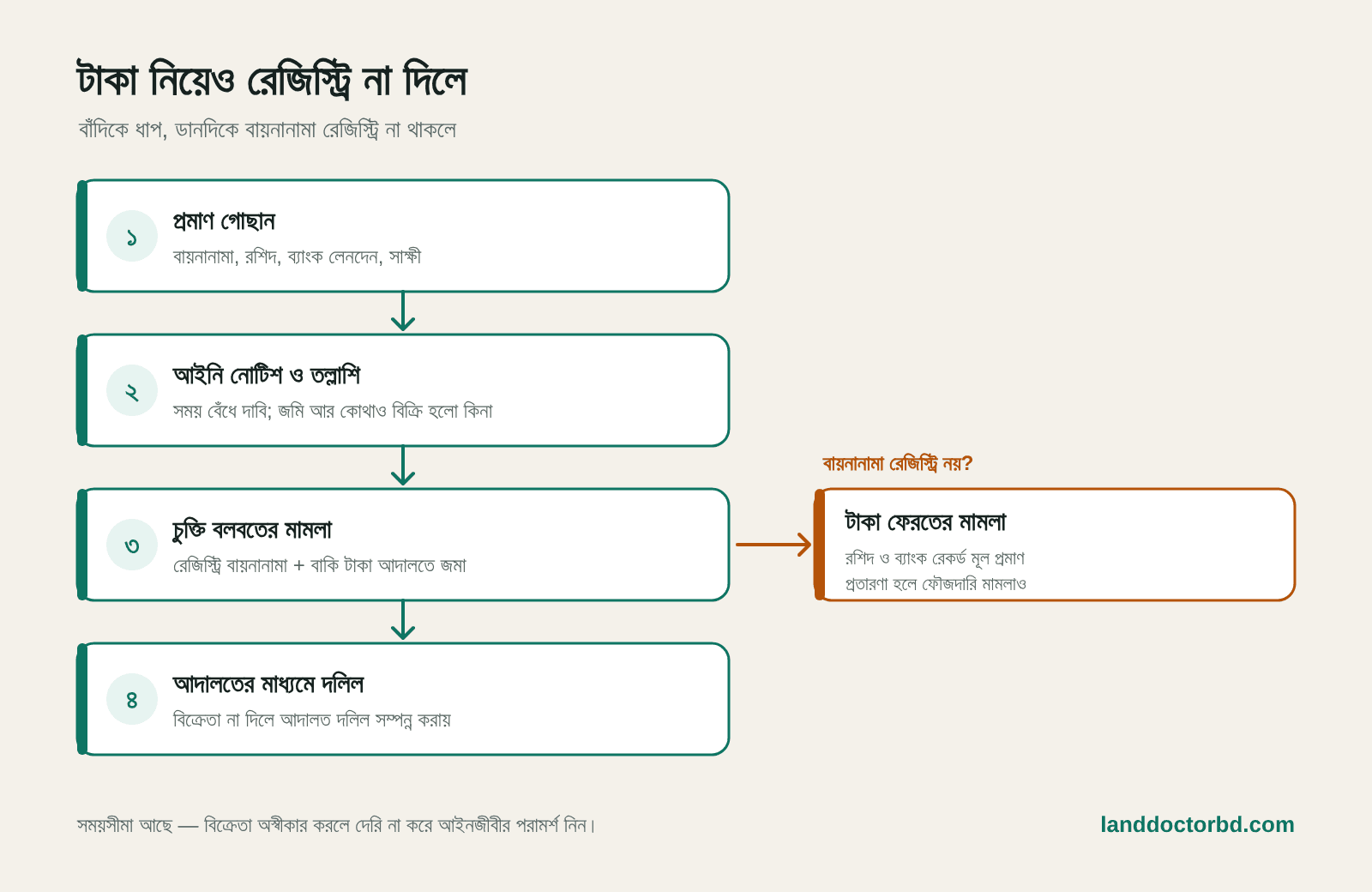
- Put the papers together. The agreement to sell (and whether it is registered), the receipts or bank proof of the money paid, the names of the witnesses.
- Send a written notice through a lawyer. Demand that the registration be done within a stated time.
- If the agreement to sell is registered, file a suit for specific performance. The money still owing has to be deposited in court when the suit is filed; the court can order the registration to be done.
- If the agreement to sell is not registered, what you can usually sue for is your money back, not the land; and a criminal case too where there has been cheating.
Do not delay — these suits have time limits, and the seller may sell the land to somebody else.
Basis of information: This post is based on the laws, the judgments of the higher courts and the news published up to October 2026 (the sources are listed below). The law and the procedure can change. Confirm with a lawyer which way is right in your case and what the time limit is.
First see what you have in hand
Which way you go depends on your papers:
| Where you stand | The usual way |
|---|---|
| The agreement to sell is registered at the sub-registry office | A suit for specific performance (to have the land registered to you) |
| The agreement to sell is only written on stamped paper, not registered | A suit for your money back; a criminal case where there has been cheating |
| There is no written agreement at all, you have only paid money | A claim for your money back on the receipts, the bank transactions and witnesses |
| The deed is registered and you have paid the whole price, but they will not give possession | Land Crimes Act 2023, section 9 — a case at the police station |
Why registering the agreement to sell matters so much: Under section 21A of the Specific Relief Act, to have an agreement for the sale of land enforced by a court the agreement has to be in writing and registered, and the money still owing has to be deposited in court when the suit is filed. In a judgment of 2025 the High Court Division held that if the money owing is not deposited when the suit is filed, depositing it later does not make the shortcoming good — the suit itself fails.
The first step: gather the evidence and send a written notice
- Put the evidence in one place. The agreement to sell, the receipts for the money, copies of the bank transfer or the cheque, the mobile banking record, messages or letters, and the names and addresses of the witnesses.
- Speak to the seller one last time — in front of a witness. Why the delay, and when the registration will be — write down whatever they say.
- Send a legal notice through a lawyer. Demand that they come to the sub-registry office and execute the deed by a stated date; write as well that you are ready to pay the money owing. Keep a copy of the notice and the postal receipt.
- Have a search made at the sub-registry office. Find out now whether the seller has sold or mortgaged the land to anybody else.
The three legal ways
A suit for specific performance (the civil court)
Where the agreement to sell is registered, this is the main way. The money still owing has to be deposited in court when the suit is filed. The court can order the seller to execute the deed; if the seller will not, the deed can be completed through the court itself. While the case is going on, a temporary injunction can be asked for so that the land is not sold to somebody else. The time limit for this suit is short, so once the seller has refused, speak to a lawyer without delay.
A suit for your money back (the civil court)
Where the agreement to sell is not registered, or you no longer want the land, a suit can be filed for the return of the money paid. The receipts, the bank transactions and the witnesses are the main evidence here.
A criminal case
- Cheating: Where the money was taken meaning to cheat from the start, or there has been an attempt to sell the same land to several people, a case for cheating can be filed.
- Where possession is not given after registration: The deed is done and you have paid the whole price, and still the seller will not give possession without good reason — under section 9 of the Land Crimes Prevention and Remedy Act 2023 that carries up to 2 years' imprisonment and a fine.
A criminal case creates pressure, but to have the land registered to you it is usually the civil suit that is needed. Which first, and which together — settle that with a lawyer.
If the seller has sold the land to somebody else
- Have a search made quickly — find out the number and date of the new deed and the buyer's name.
- If your agreement to sell is registered, the later buyer may be taken to have been able to know of your agreement; in a case that is a strong argument on your side.
- Ask the court for an injunction, so that the land does not change hands again.
- Where the sale was made on forged papers or false information, there is room for a case under the cheating and forgery sections of the Land Crimes Act (up to 7 years' imprisonment).
Keeping out of this trouble in future
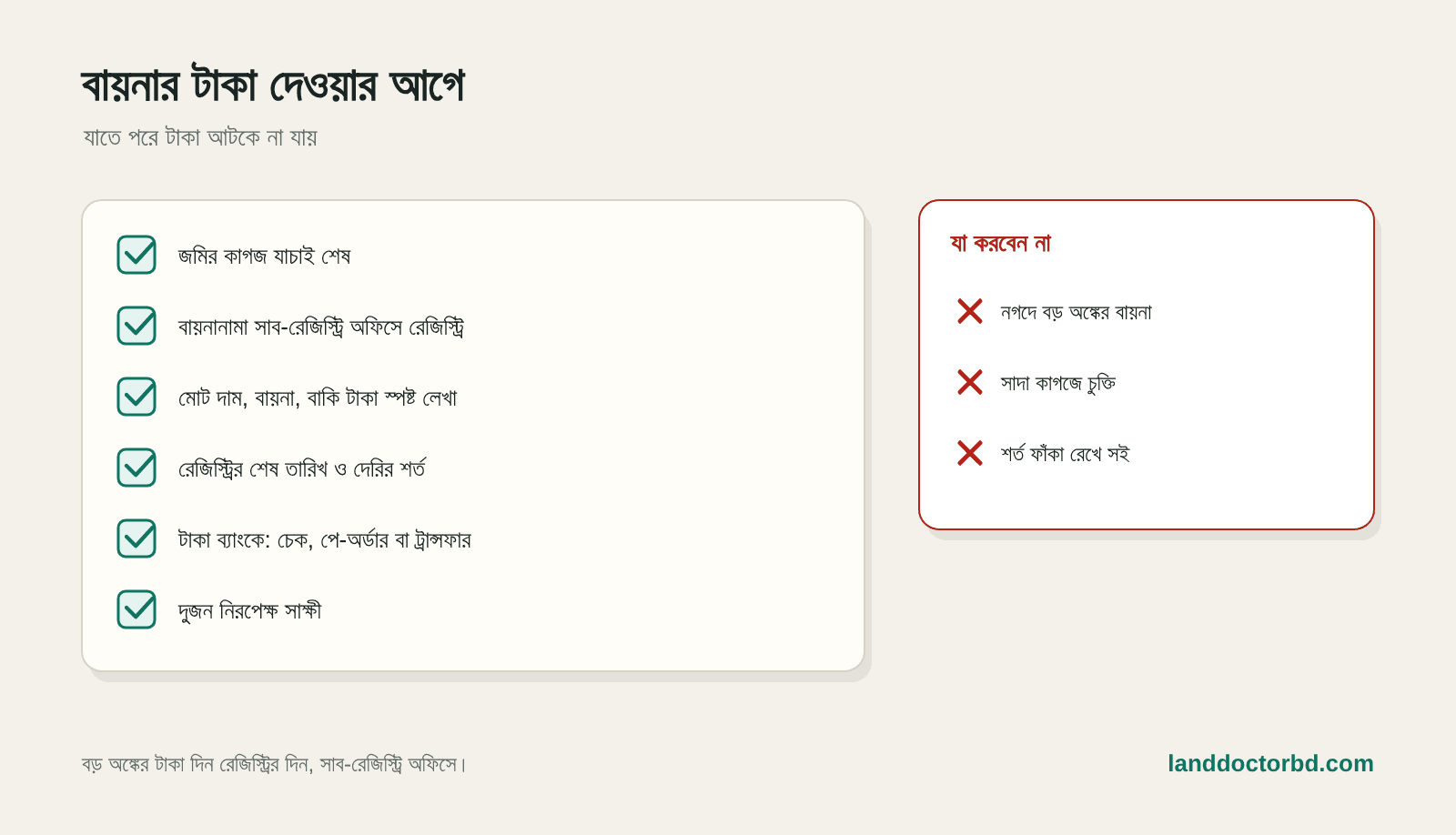
- Check the papers before you buy. Our post "What to check before buying land" has the whole checklist.
- Register the agreement to sell. That keeps the way to a suit for specific performance open, and a search will turn your agreement up.
- Write it plainly in the agreement to sell: the total price, how much you have paid, when the rest is due, the last date for registration, and what happens if it is late.
- Pay through a bank, not in cash. The record of a cheque, a pay order or a bank transfer is the strongest evidence there is.
- Keep the earnest money small. Pay the large sum on the day of registration, at the sub-registry office.
When to get expert help
In this dispute both the time and the first step matter. Take advice without delay in any of the situations below:
- The seller will not answer the telephone, or refuses outright
- The agreement to sell was not registered
- You hear that the seller is trying to sell the land to somebody else
- The seller has died and the heirs will not execute the deed
- You are abroad, with nobody in the country to run about for you
A verified LandDoctor expert will look at your agreement to sell and your proof of payment and explain which way to go, and how fast. Advice online and by telephone anywhere in the country. The first 10 minutes of advice are free.
Common questions
If the agreement to sell is not registered, is it invalid?
No, it is not invalid — it serves as evidence of the payment and of the agreement. But if it is not registered, a suit to have the land registered to you by the court (specific performance) cannot be filed; what is usually left then is the way of getting your money back.
I have not paid the rest of the money yet. Do I need the whole sum to file a suit?
In a suit for specific performance the money owing has to be deposited in court at the time the suit is filed. That money stays in the court's custody; the seller receives it later, according to the judgment.
The seller says the agreement has run out and he will not give the money back. Is that right?
It depends on what the agreement to sell lays down, and on who is to blame for the delay. If the registration did not happen because of the seller, he cannot keep the money. Take a lawyer's advice on the agreement.
The seller has died. What happens now?
The obligation under the agreement falls on the heirs. Where there is a registered agreement to sell, the deed can be asked of the heirs; if they will not, a case has to be filed against them.
Can a case be run from abroad?
Yes. Through a power of attorney attested at the embassy you can give somebody in the country charge of running the case on your behalf.
Sources
Written by LandDoctor team · Last updated: 18 November 2026
- ভূমি অপরাধ প্রতিরোধ ও প্রতিকার আইন, ২০২৩ — বাংলাদেশ আইন (bdlaws) (২০২৩)
- ভূমি অপরাধ প্রতিরোধ ও প্রতিকার আইন ২০২৩ বিষয়ে জানেন কি — দ্য ডেইলি স্টার বাংলা (জুন ২০২৪)
- সিভিল রিভিশন ৬২৪৪/২০২৩ (সুনির্দিষ্ট প্রতিকার আইন, ধারা ২১ক) — বাংলাদেশ সুপ্রিম কোর্ট (আগস্ট ২০২৫)
- বায়না দলিল: যা জানা জরুরি — যুগান্তর (ডিসেম্বর ২০২৫)
This post is general information, not legal advice. Every agreement and every case stands differently, and the law and the procedure change from time to time. Take a lawyer's advice before filing a case.